Ut tellus dolor, dapibus eget, elementum ifend cursus eleifend, elit. Aenea ifen dn tor wisi Aliquam er at volutpat. Dui ac tui end cursus eleifendrpis.
Phone No:
(+91 99109 04079)
H 143, Gurunanak Market, Mehrauli – Badarpur Rd, Lal Kuan, New Delhi, Delhi 110044
Email Address: aretepowertech@gmail.com


Lightning Arrester – Protection Against Lightning & Surge Voltages
Lightning is one of the most powerful natural phenomena, capable of causing catastrophic damage to buildings, electrical systems, and human life. A single strike carries millions of volts and thousands of amperes of current, which, if not safely discharged, can result in fire, equipment damage, or fatalities.
A Lightning Arrester is a safety device designed to protect electrical installations from such dangers. It provides a safe path for lightning current to travel into the ground, preventing surges from entering the electrical system.
👉 For high-performance lightning arresters, visit www.aretepowertech.co.in
.

Or an actual quality percentage figure (e.g., “99.9% reliability” for your earthing products
A lightning arrester is a protective device installed at the top of buildings, towers, or electrical equipment to intercept high-voltage surges caused by lightning or switching operations.
It absorbs or diverts the surge energy safely into the earth.
It ensures continuous protection for electrical systems and structures.
It is also known as a surge diverter or lightning protection system (LPS).
Lightning Strike: When lightning strikes, a massive voltage surge travels toward the structure.
Arrester Action: The lightning arrester detects the over-voltage and provides a low-resistance path to ground.
Discharge to Earth: The surge current flows into the ground through the arrester’s connected earthing system.
System Protection: The connected electrical equipment remains unaffected, ensuring safety.
👉 Without an arrester, lightning can directly enter the system, causing fire, damage, or electrocution.
Protects Human Life – Prevents accidents and fatalities from lightning strikes.
Prevents Fire Hazards – Reduces risk of fire in residential and industrial areas.
Protects Electrical Equipment – Safeguards transformers, generators, and appliances.
Ensures Uninterrupted Power Supply – Minimizes downtime due to surge damage.
Compliance with Standards – Mandatory in many industries as per IEC, IEEE, and IS codes.
Lightning arresters come in different designs based on applications:
A simple metallic rod installed at the highest point of a building.
Connected to an earthing system with copper or GI strips.
Protects small buildings and residential houses.
A hollow metallic pipe with a spark gap.
Provides better discharge efficiency than rod type.
Commonly used in medium-size buildings.
Advanced technology arrester with an early discharge system.
Provides wider coverage area compared to rod arresters.
Preferred for large commercial and industrial complexes.
Installed in power stations, substations, and distribution systems.
Protects electrical equipment from switching surges as well as lightning.
High discharge capacity (up to 200 kA)
Weatherproof and corrosion-resistant body
Wide protection radius (depending on type)
Maintenance-free operation
Long service life (20–30 years)
Compliance with IS/IEC/IEEE standards
Discharge Current: 50 kA – 200 kA
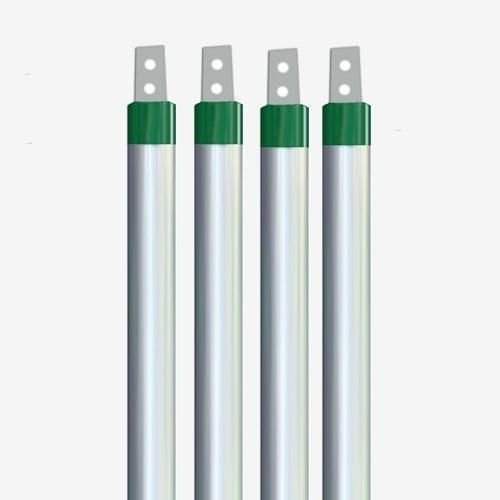
Body Material: Copper, aluminum, or galvanized steel
Height/Length: 1m – 5m (depending on application)
Protection Radius: Up to 100 meters (for ESE type)
Standards: IS 2309, IS 3043, IEC 62305, IEEE 80
Residential Buildings – Protect homes from direct strikes
Commercial Complexes – Offices, malls, hospitals, schools
Industrial Plants – Factories, refineries, manufacturing units
Telecommunication Towers – Prevent downtime in mobile networks
Power Stations & Substations – Safeguard transformers and switchgear
Renewable Energy Plants – Solar farms and wind turbine installations
Data Centers & IT Parks – Protect sensitive IT equipment
Tools & Materials Required
Lightning arrester (rod, pipe, or ESE type)
Earthing system (copper rod, GI electrode, or chemical earthing)
Copper/GI strips for connections
Fasteners and brackets
Step-by-Step Installation
Site Selection: Install at the highest point of the structure.
Mounting: Fix the arrester using brackets or clamps.
Earthing Connection: Connect arrester to an independent earthing electrode.
Testing: Measure earth resistance (should be < 5 ohms).
Inspection: Verify that all connections are tight and corrosion-free.
Use multiple arresters for very tall or wide buildings.
Maintain a separate earthing system for the arrester.
Conduct resistance testing annually.
Lightning Arresters are essential for protecting human life, electrical systems, and property from the destructive effects of lightning strikes. Whether for a home, commercial complex, industrial plant, or telecom tower, installing a lightning arrester ensures safety, reliability, and compliance with international standards.